
 Write a review


 Sign up

Repair or Replace Your Appliance? The Decision Guide That Actually Saves Money
The most expensive sentence in appliance ownership is "while you're here, just replace it." The second most expensive is "keep repairing it" on a …
Most "small appliance" advice on the internet is one sentence: throw it away. That advice is correct for a $25 blender and wrong for a KitchenAid stand mixer, a commercial espresso machine, a vintage sewing machine, or a high-end food processor still under parts support. The category exists on GigoPro because specialty shops still rebuild gears, replace motors, and keep tools alive that big-box returns would landfill.
This guide draws the real line: which small appliances deserve a bench fee, what those repairs cost, what you can safely DIY, how warranties and authorized service work, and how to find a shop that actually stocks gears instead of upselling a new SKU.
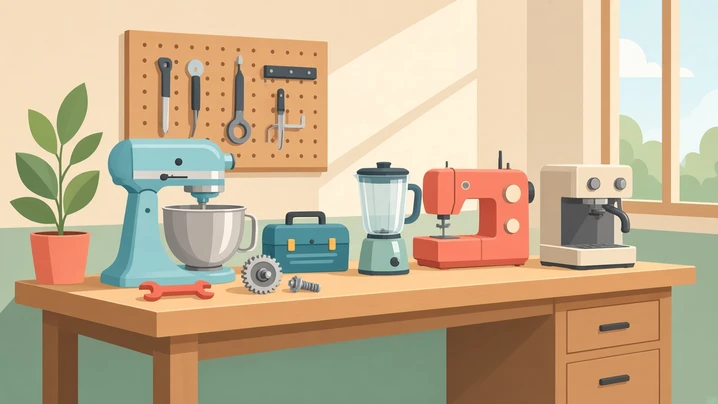
| KitchenAid / premium stand mixers | Gear wear, worm gear grease, motor brushes — shops rebuild these for decades |
| High-end blenders / food processors (Vitamix, Breville, Magimix class) | Drive sockets, containers, couplings — if parts exist and unit is <10 years |
| Espresso / coffee machines (prosumer & commercial) | Gaskets, pumps, solenoids, descaling failures — specialty benches exist |
| Sewing machines (mechanical & computerized mid/high) | Timing, belts, feed dogs, tension — sewing machine shops are a distinct trade |
| Irons / steam stations (premium) | Only if soleplate/boiler parts are available and unit cost was high |
| Commercial / light-commercial countertop | Often repairable; downtime cost beats replacement for cafés and caterers |
Rule of thumb: if the appliance cost more than ~$150–200 new, has metal gearing or a replaceable motor, and parts are still sold, get a bench quote before you trash it.
Classic failure: planetary grinding noise, grease leaking into the bowl, or intermittent power. The planetary gear / worm gear pack is a known wear item. A competent small-appliance shop cleans, regreases, and replaces worn gears — often $80–200 depending on parts. Avoid "just buy new" if the bowl and attachments are the ecosystem you're invested in.
Drive couplings, jar base sockets, and overload-tripped motors dominate. Confirm the jar isn't the only failed part before authorizing a motor job. Container-only replacements are often DIY with OEM parts.
Scale kills machines. Descale on schedule. Beyond that: pump pressure loss, leaking group gaskets, failed thermostats/PID sensors. Prosumer machines have parts ecosystems; capsule machines often don't — treat those closer to disposable unless the brand publishes service parts.
Heating-element and control failures are common; economics rarely favor repair unless the unit was expensive and still under parts support. Safety first: damaged cords and compromised insulation mean stop using, don't "temporary tape."
Sewing Machine sits under Small Appliance in the GigoPro taxonomy for a reason — general appliance techs are not sewing techs.
| Bench / diagnostic fee | $40–90 | Often applied to repair |
| Mixer gear / grease service | $80–200 | Parts drive the top end |
| Blender coupling / jar base | $40–120 | Sometimes parts-only DIY |
| Espresso gasket / pump work | $80–300+ | Commercial higher |
| Sewing machine tune / timing | $60–180 | Computerized boards extra |
| Motor replacement (small) | $70–200 | Only if motor is sourced |
If the quote approaches the price of a comparable new unit with warranty, walk — unless attachments, commercial duty, or vintage value change the math. See also the series Repair or Replace? guide.
Usually safe: cleaning, descaling per manual, replacing blender jars/lids, tightening feet, replacing accessible belts on some sewing machines with the manual open, swapping mixer attachments and bowls.
Stop: opening sealed motors under power, microwave-adjacent repairs (different hazard class), gas connections on any hybrid appliance, and anything that defeated a thermal fuse without finding why. Capacitors in some motor circuits hold charge — if you're not sure, you're not the tech.
Yes. Gear and grease service is one of the most legitimate small-appliance repairs left. Use a shop that has done them before — ask.
Unplug and stop using. Burnt windings or melted couplings can be repairable on premium units; on cheap ones, replace. Don't run it "a little more."
Usually no. Timing and feed systems are a specialty. Look for sewing machine service explicitly.
Search the model number + "parts diagram" or ask the shop to check before you pay a full diagnostic. No parts = replace.
Sometimes — if local shops won't touch it. Factor shipping both ways and insurance into the 50% math.
Find small appliance and sewing machine repair shops on GigoPro — compare reviews, ask about your exact model, and get a bench quote before you landfill a tool that still has years left.
The most expensive sentence in appliance ownership is "while you're here, just replace it." The second most expensive is "keep repairing it" on a …

Laundry failures are the other great appliance emergency: a washer that won't drain floods the floor; a dryer that won't heat strands the househol…
A warm refrigerator is not a minor inconvenience — it's a clock on hundreds of dollars of food, a food-safety problem, and one of the highest-inte…
"How much does appliance repair cost?" sounds simple. It isn't. A $35 service call that clears a jammed garbage disposal and a $1,800 sealed-syste…
Comments
0 commentsTo add a comment you need to sign in.
No comments yet. Be the first!